Blog · Blogs
Lightweight partitions vs fired clay brick walls: a 10-criteria comparison
Choosing a partition material is one of the decisions that will have the most lasting impact investment costs, construction progress and operating quality of the project. Vietnam market There are currently many groups of materials being introduced as solutions to replace brick walls traditional, but technical parameters are often published under different measuring conditions, makes comparison and selection difficult.
This article summarizes the evaluation results Seven common groups of partition materials above ten technical and economic criteria, all refer to the same condition: wall thickness 100 mm. Data are extracted from the technical topic conducted by HASS in 2025, in the process of calculating partition replacement options for a 33-storey apartment project in the southern region.
HASS is a producer of AAC blocks and ALC wall panels, two of the materials mentioned. Therefore, we keep the criteria that our products do not achieve the best results, At the same time, clearly state the measurement conditions of each data so that you have an independent basis for comparison with other suppliers.
Current status of traditional partitions
Partitions in civil works in Vietnam mainly use two solutions: wall built of tunnel bricks (fired clay bricks) and reinforced concrete walls. Both have time-tested durability and are compatible with common construction practices. However, these two solutions pose two issues that investors need to consider right from the beginning base design.
First is the load. The 100 mm thick fired clay brick wall has a mass of approx 180 kg/m². This is the static load that the foundation, column and beam system must receive throughout its life cycle construction. For high-rise buildings, increased wall volume means increase volume of concrete and reinforcement in the underlying structure.
Second is the number of wet construction stages. After construction, the wall needs to be plastered two sides, entailing mortar costs, labor costs and drying time before plastering and painting complete. On the progress chart, this is often the item with a high risk of delay.
The group of lightweight materials was developed to solve the two problems mentioned above. It should be noted that “lightweight materials” is not a single category, but a collection of many materials have significantly different structures, prices and technical characteristics.
Characteristics of seven groups of materials for making partitions
The table below summarizes the structure and characteristics of each group. Quantitative data is in the evaluation section Ten criteria below.
| Material | Structure | Advantage | Limit |
|---|---|---|---|
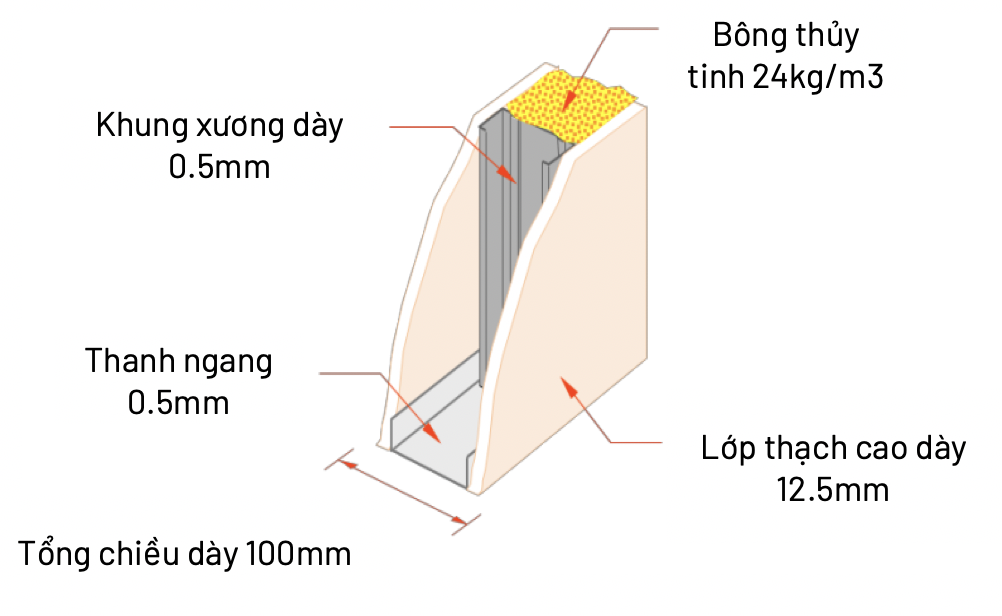
| Drywall | The plasterboard is attached to the steel frame, with a hollow cavity in the middle | Lightest in the group (35 kg/m²), quick to construct, easy to dismantle, good sound insulation, no need for plastering | Easy to absorb water and yellow, poor impact resistance, lifespan only 10–20 years |
| PVC wall, PVC Foam | PVC plastic pressed into sheets; PVC Foam has a double-sided solid skin and foam core | No termites, good water resistance, fast construction, diverse colors | Brittle, poor bearing capacity |
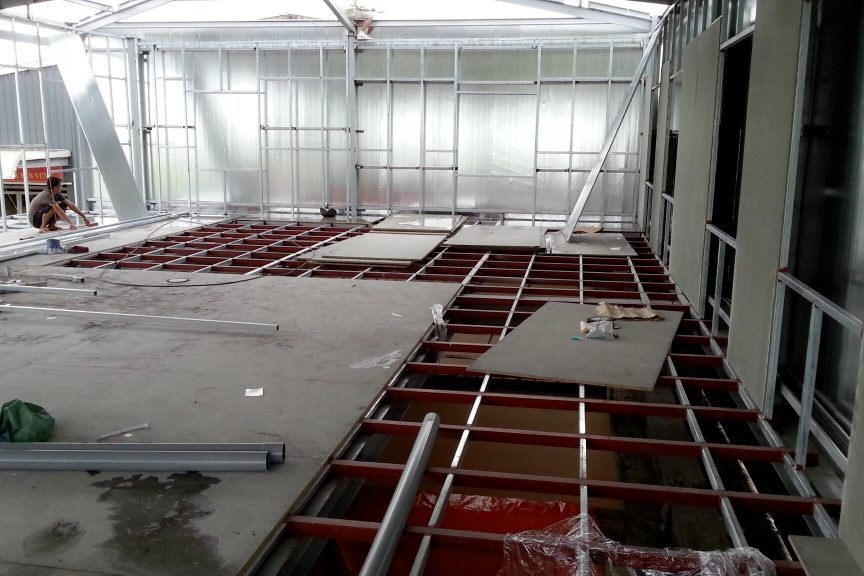
| Cement panel walls | Cement mixed with wood chips or cellulose fibers, hydraulically pressed into panels (Cemboard, cellulose) | Lightweight, quick to construct, quite heat-insulating and fire-resistant, and has good standing strength | Poor horizontal load-bearing, easy to crack upon impact, higher cost than masonry walls |
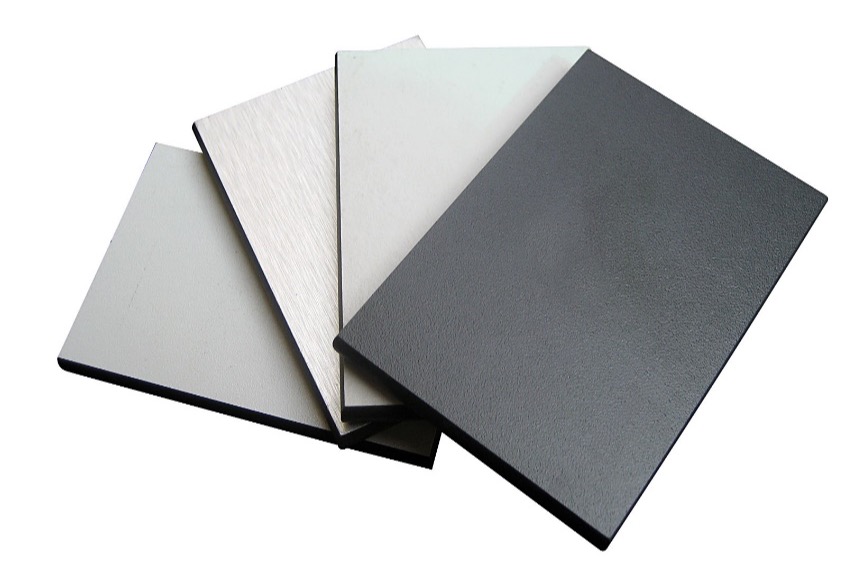
| Compact HPL wall | Multiple layers of Kraft paper soaked in heat-pressed phenolic resin, coated with melamine | Hard, non-warping, completely waterproof, quick to assemble | High cost |
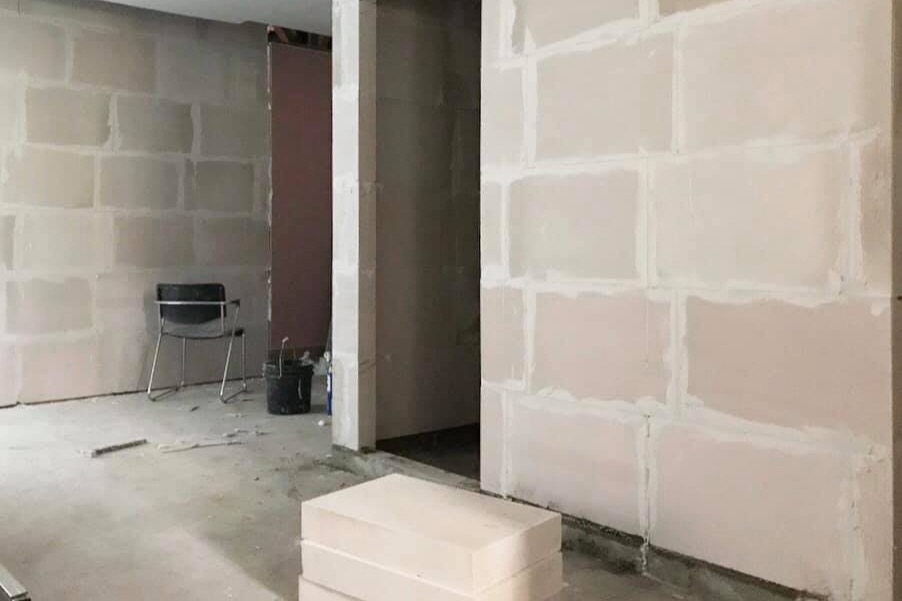
| AAC blocks and ALC wall panels | Cement, lime, sand, and gypsum are autoclaved at 200 °C to create closed air bubbles; ALC panels have additional Ø4–Ø5 mm steel mesh | One-third as light as a brick wall, fireproof and good heat and sound insulation, fast construction, lifespan ~100 years | The compressive strength is lower than that of fired clay bricks, the material price is higher, and requires separate construction techniques |
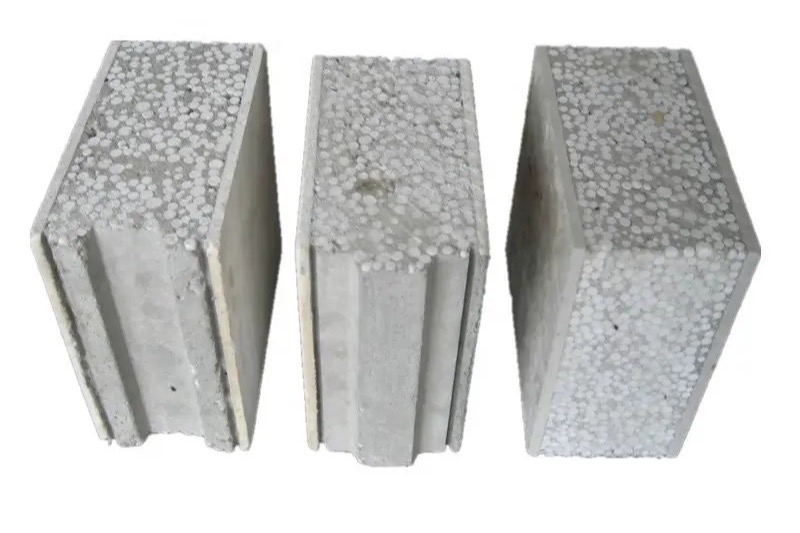
| Polystyrene concrete panels | Sand, cement, water mixed with EPS foam beads, there is a type of double-sided fiber reinforced cement panel | Half as light as a brick wall, fireproof, good sound insulation and thermal insulation, low water absorption | Easy to crack at the connection with the column, high cost |
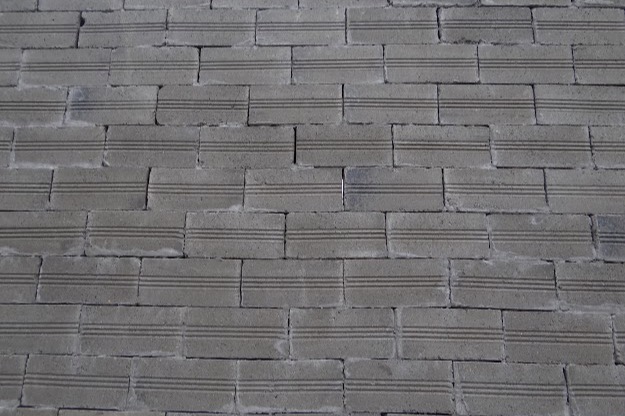
| Aggregate cement bricks | Cement combined with stone dust, sand, and thermoelectric slag; The pellet has hollow holes along the body | Low waterproofing and water absorption, uniform surface, reducing plastering by up to 2.5 times | Heavier than fired clay bricks so the load cannot be reduced and the cost is higher |
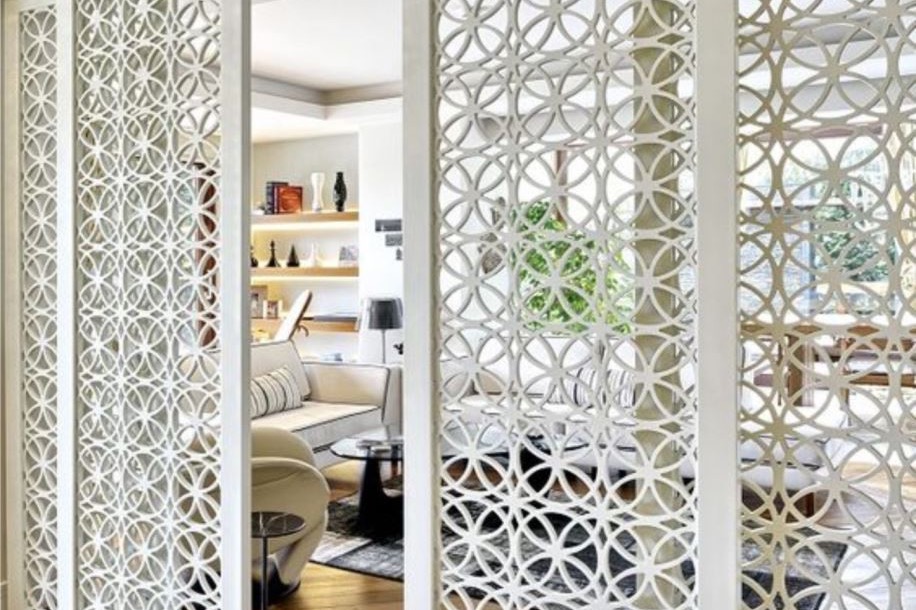
The structure of each group can be seen in the picture:
In the seven groups mentioned above, PVC Foam panels and Compact HPL panels Mainly used for walls dry interior, not competitive in the large-area divider category. Quantitative assessment section below here so focus on five materials can replace walls on a large scale, Placed in relation to the brick wall as a landmark.
Evaluated on ten criteria, all referred to a wall thickness of 100 mm
1. Load
Drywall has the lowest mass. AAC blocks and ALC wall panels are lighter than fired clay brick walls about two-thirds while still being a solid wall structure. The number 55 kg/m² in the chart is the value according to catalog; Actual production proportion at HASS factory in 2025 and 2026 for 100 mm wall is approx 55 to 60 kg/m². Particularly aggregate cement bricks has a mass 5.56% higher than the brick wall, so it does not meet the target of load reduction.
This is the criterion that has the greatest indirect impact on total investment. The reduction of wall mass This leads to a reduction in the volume of concrete and reinforcement of the foundation system, columns and beams. For high-rise buildings, The cost savings in the structure are often greater than the difference in unit price of wall materials.
2. Compressive strength
| Material (100 mm wall) | Compressive strength | Compared to brick walls |
|---|---|---|
| Fired clay bricks | 7.5 MPa | comparison benchmark |
| ALC wall panels | 3.5 – 7.5 MPa | lower |
| AAC blocks | 3.5 – 7.5 MPa | lower |
| Polystyrene concrete | 4 MPa | lower |
| Drywall | not the same unit of measure | — |
| Cement aggregate | 7.5 MPa | equivalent |
This is the only criterion among the ten criteria that the lightweight materials group did not achieve equal results brick wall. There are three things that need to be understood correctly when reading the above table.
The first, partitions are not load-bearing structures. In a concrete frame house reinforcement, vertical load received by the column and beam system; The wall only carries its own weight and subjected to lateral loads such as wind or impact. Strength from 3.5 to 7.5 MPa is sufficient this role.
Monday, the strength of plasterboard is determined in force units (N), MPa is not used as bulk materials, so it cannot be placed in the same comparison column. In fact, drywall had the lowest impact resistance in the survey group.
Tuesday, the requirement to hang heavy objects on light walls is a matter of bonding solutions, not of material strength. This content is presented in the article Instructions for hanging things on lightweight concrete walls.
3. Fire resistance
AAC blocks and ALC wall panels reach 240 minutes, twice as long as brick walls and four times as long as drywall. The 240 minute result was established on the wall sample AAC HASS bricks 100 mm thick according to Inspection minutes of the Center for Research and Application of Fire Prevention and Fighting Science and Technology In 2018, tested according to TCXDVN 342:2005 and ISO 834. This level corresponds to EI 240 according to QCVN 06:2022/BXD. For many construction items, the 60-minute drywall limit is not met Request for acceptance of fire prevention and fighting.
Besides the fire resistance limit, it should be noted that AAC blocks and ALC wall panels are inorganic materials, Non-flammable and does not emit toxic fumes under fire conditions. This is an important factor for life safety, in addition to the requirement to prevent fire spread.
4. Acoustic insulation ability
All five alternative materials have better sound insulation than brick walls. Drywall achieves the best results thanks to its multi-layer structure with hollow cavities. AAC blocks and ALC wall panels reach STC 38, 36% higher than brick walls, due to the closed air bubble structure disperses sound wave energy when passing through walls. This is the measurement result on the AAC HASS wall 100 mm thick according to the test report of the Institute of Construction Structures, Institute of Construction Science and Technology (contract 196/2017 VKC); 200 mm thick wall reaches STC 44.
In practice, sound insulation criteria rarely stand alone. For the middle wall For apartments, sound insulation requirements always come with fireproof and longevity requirements, so they need to be considered table by cluster of criteria. Related content is presented in the article Harmful effects of noise and remedies.
5. Thermal insulation ability
Fired clay brick walls have a thermal conductivity coefficient more than seven times higher than AAC blocks, ALC wall panels and drywall. The closed air bubble structure in autoclaved concrete acts as an insulating layer Evenly distributed throughout the material, helping to maintain a more stable and reduced indoor temperature Electricity costs for air conditioning systems.
This is also a target directly related to QCVN 09:2017/BXD on efficient energy use. in construction works. Specific solutions for buildings subject to large solar radiation are presented in the article heat resistant West and southwest facing house.
6. Water absorption
| Material (100 mm wall) | Water absorption |
|---|---|
| Cement aggregate | 8% |
| Polystyrene concrete | 14% |
| Fired clay bricks | 20% |
| Drywall | 20% |
| AAC blocks and ALC wall panels | 25% |
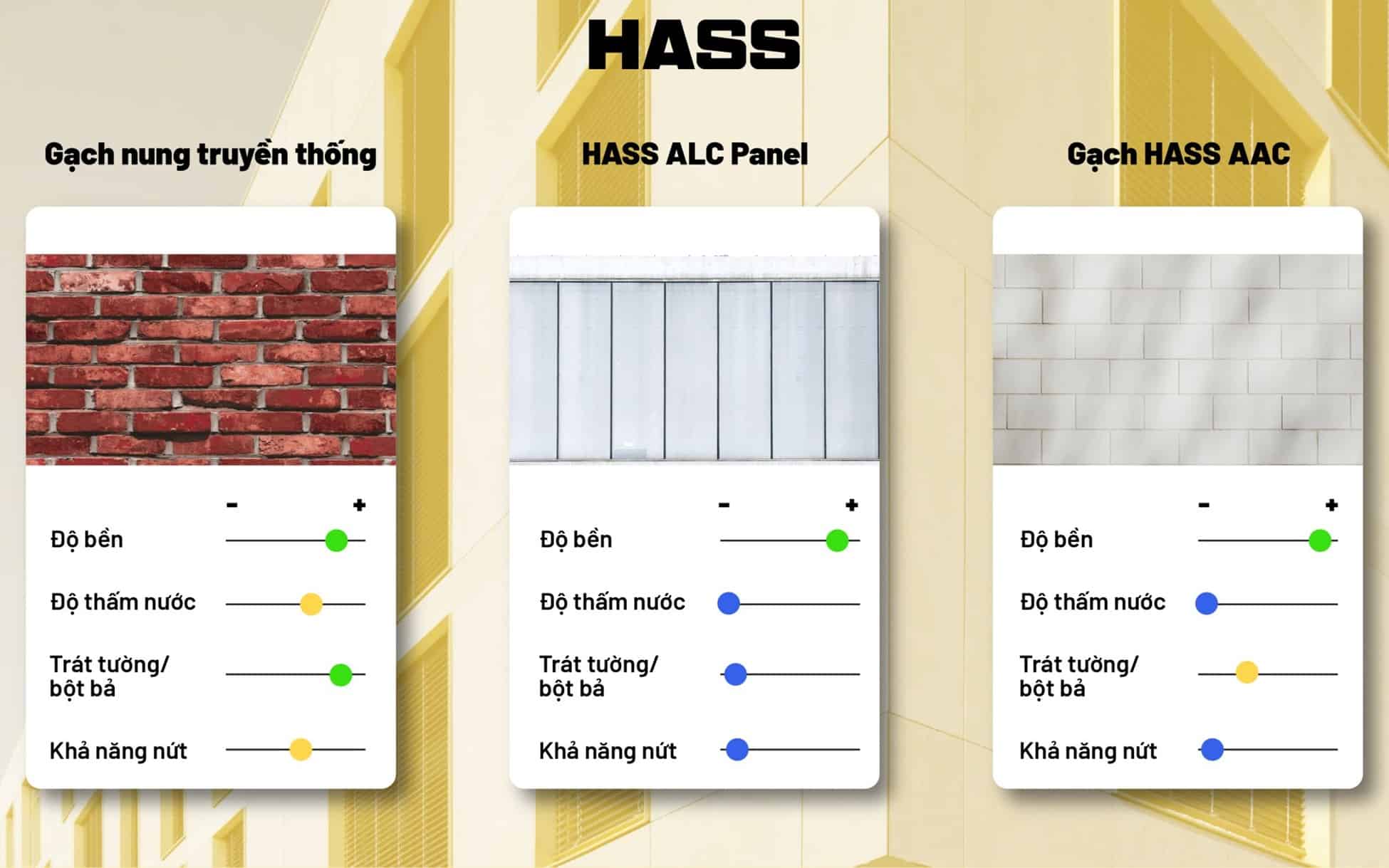
In this criterion, AAC blocks and ALC wall panels are present highest water absorption in the survey group. It should be noted that the values in the table are Industry reference number, not the result testing conducted by HASS. However, it is necessary to place the data in a full technical context: the phenomenon of seepage in construction mainly occurs through masonry joints, junctions and wall penetrations, rarely occurring through the material itself.
The structure of air bubbles in autoclaved concrete is closed air bubbles, not interconnected. Water is retained in the surface layer and evaporates again when weather conditions permit, does not penetrate the wall by capillary mechanism like fired clay bricks. Conditions to ensure waterproofing are: Use the correct specialized mortar, thoroughly handle gaps and apply waterproofing at the right location by design. Related content is presented in the article Causes of seepage and remedies reason.
7. Construction speed
ALC wall panels achieve a productivity of 30 m² per worker per day, 275% higher than brick walls. AAC blocks reach 24 m², 200% higher, thanks to large brick size and thin circuit construction method. This is the reference norm; Actual productivity depends on construction team skills and conditions premises of each project.
For investors, the significance of this criterion lies not only in labor costs but mainly at the time of handover. Shortening the body's progress means reducing internal interest costs construction time and putting the project into operation sooner. This is often the reason for projects High-rise buildings choose ALC wall panels even though the unit price of materials is higher.
8. Longevity
| Material | Reference lifespan |
|---|---|
| Fired clay bricks | about 100 years |
| AAC blocks and ALC wall panels | about 100 years |
| Cement aggregate | about 100 years |
| Polystyrene concrete | about 50 years |
| Drywall | 10 to 20 years |
Longevity is a factor that is often overlooked when comparing initial investment costs. With construction there With a service life of 50 years, drywall needs to be replaced at least twice during its life construction. Replacement costs, along with the cost of interrupting operations in the area during the period repairs, often exceeding the difference in initial investment.
9. Number of construction stages
| Material | Step sequence | Total |
|---|---|---|
| Fired clay bricks | Build rough walls → plaster both sides | 2 |
| AAC blocks and ALC wall panels | Build or install rough walls → apply mesh | 2 |
| Polystyrene concrete | Panel installation → surface treatment | 2 |
| Drywall | Build the skeleton → catch the plate | 2 |
| Cement aggregate | Construction → plastering → surface treatment | 3 |
It is important to note that the second step of the AAC block and ALC wall panel option is Paste the mesh, not thick plaster. This is the content that determines the cost comparison results in the next section.
10. Investment costs
The costs below are for one square meter of rough finished 100 mm wall, excluding work putty and paint, according to the price level in the southern region in 2025. Figures include materials and labor and surface finishing steps corresponding to each type of material.
| Plan (100 mm wall) | Total cost 1 m² |
|---|---|
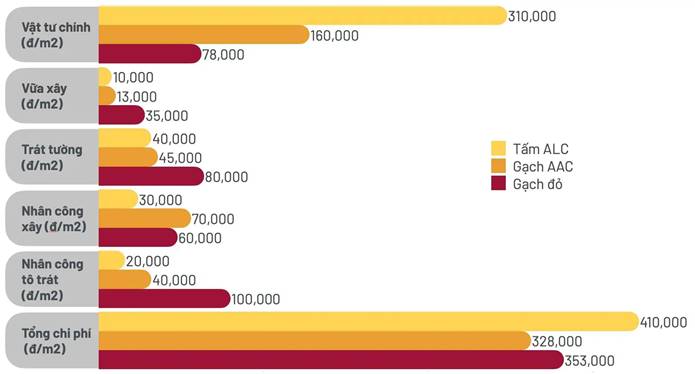
| AAC blocks | about 328,000 VND |
| Fired clay bricks | about 353,000 VND |
| ALC wall panels | about 410,000 VND |
Compared to fired clay brick walls, the AAC block option saves approx 7% of wall costs. It is worth noting this savings does not come from material prices: Calculated per square meter of wall, the unit material price of AAC blocks is higher than that of fired clay bricks.
The difference arises from the construction sequence. There is no need for walls built with AAC blocks according to technical specifications The mortar layer is thick on both sides, just need to glue the mesh and putty to finish, while the brick wall must be plastered two sides with mortar and labor costs included. This is also the reason If the contractor still plasters AAC walls follow the traditional brick construction practice, the savings will no longer exist; In addition, Thick cement mortar layer on AAC base has the risk of cracking due to the shrinkage of the two materials.
For ALC wall panels, the higher cost in the table only reflects the wall part, not including the two The item that this material brings: structural cost savings thanks to reduced wall volume about two-thirds, and the value of shortening the schedule thanks to 275% higher construction productivity. For high-rise buildings, these two amounts often exceed the difference in wall costs.
Scope of application of data: The above numbers are reference prices in 2025 for walls 100 mm thick rough finish. Townhouses, factories or buildings in other areas there will be different results. Please refer to actual unit price Current price quote of HASS or calculate the volume by materials calculation tool.
Summary of evaluation results
| Criteria | ALC panels | AAC blocks | BT Polystyrene | Plaster | XM aggregate |
|---|---|---|---|---|---|
| Load | ✓ | ✓ | ✓ | ✓ | – |
| Compressive strength | – | – | – | – | ✓ |
| Fireproof | ✓ | ✓ | ✓ | – | ✓ |
| Acoustic insulation | ✓ | ✓ | ✓ | ✓ | ✓ |
| Thermal insulation | ✓ | ✓ | ✓ | ✓ | ✓ |
| Water absorption | – | – | ✓ | ✓ | ✓ |
| Construction speed | ✓ | ✓ | ✓ | ✓ | ✓ |
| Longevity | ✓ | ✓ | ✓ | – | ✓ |
| Number of construction stages | ✓ | ✓ | ✓ | ✓ | – |
| Expense | – | ✓ | – | ✓ | – |
According to the summary, AAC blocks and Polystyrene concrete both achieve 8 out of 10 criteria; ALC wall panels, drywall and aggregate cement bricks each achieve 7 out of 10. This result should be read together with the characteristics of each project, because the weight of each criterion is not uniform in all cases.
Recommended selection according to project type
Apartments and high-rise buildings have progress requirements: ALC wall panels. Assembly capacity of 30 m²/person/day, load reduction of about two-thirds and fire resistance limit of 240 minutes are three factors that usually offset the roughly 16% difference in wall unit price.
Residential houses, townhouses and houses for rent: AAC blocks, with wall costs about 7% lower than fired clay brick walls, three times higher construction speed and superior thermal insulation. Specific application cases are presented in the article xây phòng trọ bằng bê tông khí chưng pressure.
Factories and buildings have strict requirements on fire prevention and fighting: ALC wall panels. Detailed content is presented in the article Complete fire protection solution representing the factory.
Office partitions are dry, the premises change frequently, and there are no requirements for support fire: Drywall is still a suitable option thanks to its low weight, good sound insulation, Reasonable cost and flexible installation, with attention to limited lifespan and fire resistance.
Toilet walls and areas regularly exposed to water: Compact HPL panels.
Note during construction
The actual effectiveness of lightweight materials depends significantly on the quality of construction. The following three contents need to be controlled in design documents and construction methods.
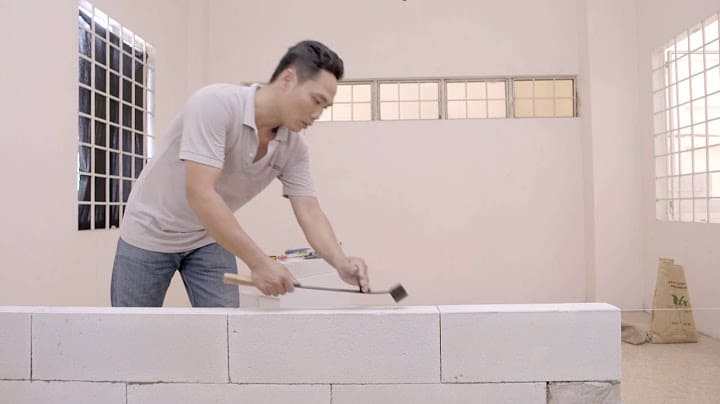
First, do not apply thick plaster according to the practice of constructing burnt bricks. AAC wall Just apply net and thin bait. Applying thick plaster destroys cost savings and increases risk crow's feet cracking due to the difference in shrinkage between the two materials.
Second, use the correct type of mortar. AAC blocks are built with specialized mortar for AAC blocks with a joint thickness of about 3 mm, instead of a 10 to 12 mm joint of cement mortar usually. The use of conventional sand-cement mortar not only increases the amount of mortar consumed, but also increases the amount of mortar consumed. It also creates a thermal bridge across the wall, reducing the structure's thermal insulation ability.
Third, thoroughly handle adjacent locations. Location of walls intersecting columns and beams, as well as locations through walls of electricity and water systems, which are the main infiltration routes. Correct handling These positions ensure the wall's waterproofing ability regardless of the water absorption index of the material.
The detailed operating sequence is presented in Construction Guide for HASS AAC Lightweight Blocks.
Conclude
Based on the evaluation of ten criteria with the same 100 mm wall thickness condition, three materials meet The requirement to replace brick walls on a large scale is drywall, AAC blocks and ALC wall panels, Each material is suitable for a different group of projects.
For projects with simultaneous requirements for load reduction, fire resistance, sound insulation, and thermal insulation and long lifespan, AAC blocks and ALC wall panels are the most balanced option in the survey group, with conditions that ensure compliance with construction technical requirements.
HASS is ready to coordinate with design consultants and contractors in the selection work Material plans, volume calculations and construction technical instructions for each project specifically.
Need a quotation or technical advice?
Send a request and the HASS technical team will respond during business hours.