Blog · Technical guidance
AAC block bedding mortar consumption: how many m² does a 50 kg bag cover?
Summary
- AAC block bedding mortar is applied as a 2-3 mm thin bed.
- Reference consumption is 3-8 kg/m² for 75-200 mm walls.
- One 50 kg bag covers approximately 16.7-6.3 m² of AAC wall.
- The HASS calculator uses an allowance of 45 kg of bedding mortar per m³ of AAC blocks.
What is AAC block bedding mortar?
AAC blocks are dimensionally consistent and have flat surfaces because they are wire-cut in the factory. An AAC wall therefore does not need a thick mortar layer to compensate for irregular blocks. HASS Block technical guidance specifies a 2-3 mm bedding joint for both bed joints and perpendicular joints. This is the basis for calculating consumption.
Thin-bed mortar differs from site-mixed cement-sand mortar in three ways:
- It is a factory-produced, one-component dry mix; only add water at the ratio stated on the bag.
- Consumption is calculated as kilograms of dry mortar per m² of wall, not as m³ of mixed mortar.
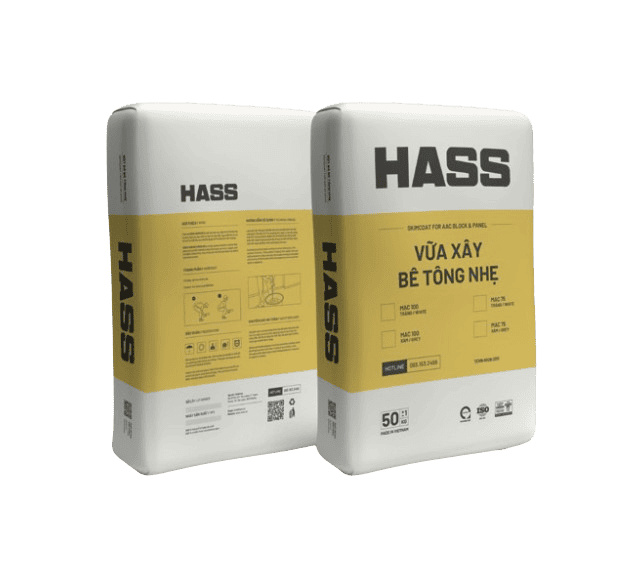
- HASS bedding mortar is supplied in 50 kg bags and should be stored sealed in a dry, ventilated area.
HASS thin-bed mortar has a specified compressive strength of at least 7.5 MPa and bond strength of at least 0.4 MPa under TCVN 9028:2011. HASS published test results show 12 MPa compressive strength, 0.7 MPa bond strength, 195 mm flow and 200 minutes to initial set.
AAC block bedding mortar consumption by wall thickness
The table below is taken from the HASS Block installation guide. It applies to 1 m² of AAC wall using a 2-3 mm bedding joint.
| Wall thickness | Bedding mortar consumption | 50 kg bag coverage |
|---|---|---|
| 75 mm | 3 kg/m² | 16.7 m²/bag |
| 100 mm | 4 kg/m² | 12.5 m²/bag |
| 150 mm | 6 kg/m² | 8.3 m²/bag |
| 200 mm | 8 kg/m² | 6.3 m²/bag |
How to use the table
- Measure total wall area, then deduct door and window openings.
- Use the row that matches the design wall thickness.
- Divide the wall area by bag coverage and round up for ordering.
Example: for 240 m² of 100 mm wall, 240 ÷ 12.5 = 19.2. Round up to order 20 bags of 50 kg mortar.
Estimate bedding mortar from the ordered AAC block volume
When the estimate is prepared from ordered block volume instead of wall area, the HASS material calculator uses an allowance of 45 kg of bedding mortar per m³ of AAC blocks, including an allowance for incomplete joints, cut blocks and site waste.
| Wall thickness | Wall area per m³ of blocks | Blocks per m³ (600 × 200 mm face) |
|---|---|---|
| 75 mm | About 13.3 m² | About 111 blocks |
| 100 mm | 10 m² | About 83 blocks |
| 150 mm | About 6.6 m² | About 55 blocks |
| 200 mm | About 4.9 m² | About 41 blocks |
Example for 20 m³ of AAC blocks: 20 × 45 = 900 kg; 900 ÷ 50 = 18 bags of 50 kg mortar.
For ordering, use the calculator result or confirm the allowance with the technical team so it reflects drawings and site conditions.
Installation practice that keeps consumption under control
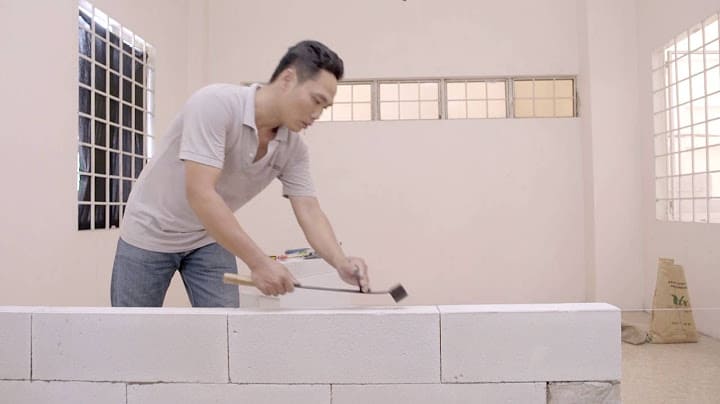
Actual consumption stays close to the table only when mortar is spread evenly at the specified thickness. A plain trowel, oversized batches and an uneven wall surface all increase material use.
Required tools
- Notched trowel: directly controls joint thickness and consumption.
- Drill-mounted mixing paddle: produces an even mortar mix and reduces lumps or excessive thickness.
- Rubber mallet and spirit level: align blocks without damaging their edges.
Four causes of excess consumption
Using a plain trowel instead of a notched trowel: joints become thicker than 2-3 mm, increasing consumption and creating a thermal bridge.
Mixing too much mortar at once: HASS recommends not using mortar more than two hours after mixing and not reusing fallen mortar.
Applying an overly thick rendering coat: work in 5-7 mm coats, with about five minutes between coats, to reduce slumping.
Skipping surface planing: uneven AAC walls require a thicker rendering layer afterwards.
After 24 hours of masonry, rendering can begin; after 72 hours, skimcoat may be applied following HASS guidance.
Frequently asked questions about AAC bedding mortar
How many square metres can a 50 kg mortar bag cover?
According to HASS Block guidance: about 16.7 m² for 75 mm walls, 12.5 m² for 100 mm, 8.3 m² for 150 mm and 6.3 m² for 200 mm.
Can ordinary cement-sand mortar be used for AAC blocks?
It is not recommended. Cement-sand mortar normally requires a thicker joint, increasing consumption and creating a thermal bridge. AAC walls are intended for dedicated thin-bed mortar for lightweight concrete.
Does consumption vary with wall thickness?
Yes, when calculated per square metre of wall: consumption rises from 3 kg/m² for 75 mm walls to 8 kg/m² for 200 mm walls because a thicker wall has a larger contact area at each joint. When calculated by block volume (m³), consumption does not change with wall thickness.
How long can thin-bed mortar be used after mixing?
HASS recommends not using mixed mortar after two hours and not reusing fallen mortar. Follow the water ratio on the bag.
Select the right mortar so the estimate matches the project
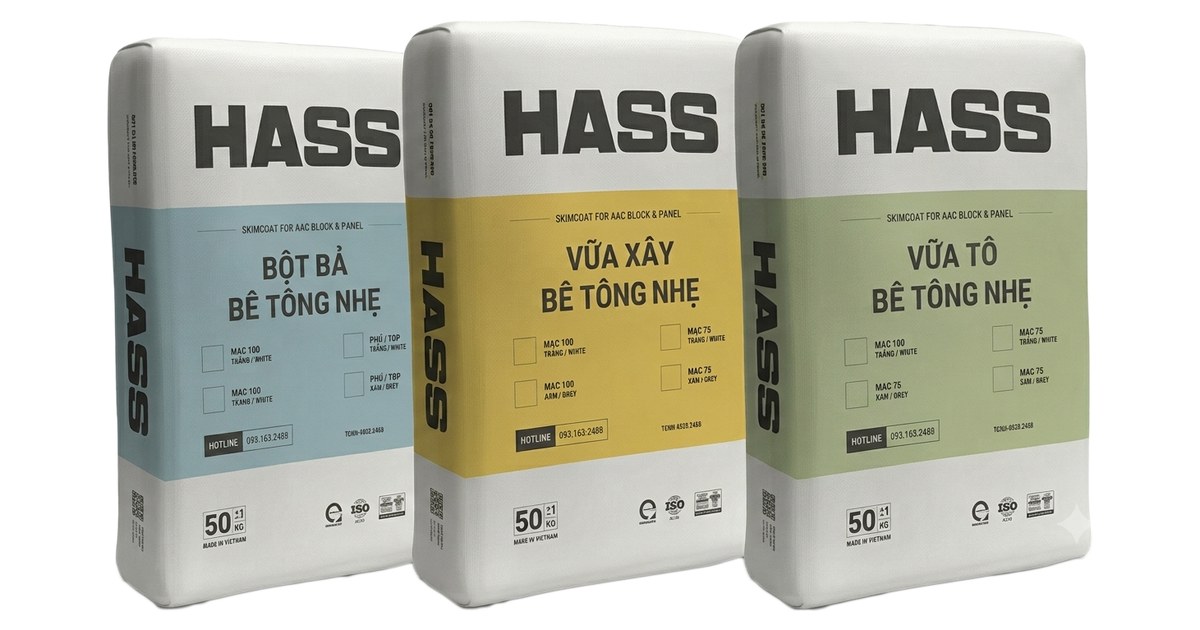
Consumption figures are meaningful only when the right mortar is used and installation follows guidance. HASS mortar is designed as part of the AAC block and ALC panel system; technical data are available at HASS Mortar and in factory certification documents.
For large projects or walls with many cuts, openings and complex connections, confirm final quantities against drawings and the installation method.
Calculate project allowance quickly
Wall length, height or area can be entered in the HASS material calculator. It returns block quantity, required volume, estimated bedding mortar bags and finishing materials.
These figures are HASS estimates and may change with drawings, material condition and actual installation. Confirm with the technical team before placing an order.
Need to calculate mortar for a project?
Enter wall area and thickness to estimate AAC blocks and bedding mortar bags.