How to calculate AAC blocks for a house — and 2 mistakes that cause shortages or over-ordering
Customers who are used to buying clay hollow bricks by the piece may hesitate when switching to autoclaved aerated concrete (AAC) blocks because the factory first asks: “How many cubic metres do you need?”
If the wall you have in mind cannot be converted into m³, most homeowners leave the estimate entirely to the contractor. The outcome usually falls into one of two cases, and both cost money.
Over-ordering: several cubic metres of blocks remain covered in a corner of the site after the house is completed; the money is tied up there and the surplus is difficult to resell. Under-ordering: the wall crew runs out of blocks in the middle of work, workers must wait, and a supplementary delivery of only a few dozen blocks still incurs a full transport charge.
The good news is that this calculation is not difficult. After reading this article, you can calculate the blocks for your house in 10 minutes with pen and paper — or in 30 seconds with the HASS material calculator.
Why are AAC blocks sold by m³ rather than by piece?
The same AAC block is available in multiple sizes. A standard block is 600 mm long, but thicknesses are 75 / 100 / 150 / 200 mm and heights are 200 / 300 mm. A per-piece quotation would require a different price for every size and quickly become confusing. A cubic metre is the base unit for the material volume: one price, with every size convertible to the same unit.
To know how much to order, convert your wall from square metres (what you can measure) to cubic metres (what the factory sells). Only one intermediate value is needed: wall thickness.
Calculate it in 3 steps
Step 1 — Measure wall area
Area of each wall =length × height(measure height to the underside of the beam or floor slab above, where the masonry wall ends).
Add the external walls around the house and all internal partition walls to obtain the total wall area.
Step 2 — Convert square metres to cubic metres
m³ = m² × wall thickness (in metres)
A 100 mm wall is 0.1 m thick. For example, 10 m² of 100 mm wall = 10 × 0.1 =1 m³. The reverse is also easy to remember:1 m³ of blocks builds 10 m² of 100 mm wall— or 5 m² of 200 mm wall.
Step 3 — Convert volume to number of blocks
Each block is a small rectangular prism with volume = length × thickness × height. The common 600 × 100 × 200 mm block has a volume of 0.012 m³. Divide the total m³ by the volume of one block and round up to obtain the quantity to order.
Example
For a 2-storey townhouse, each floor has 40 m of total wall length (external + partitions) and a height of 3 m:
• Wall area: 40 × 3 × 2 floors =240 m²
• Convert to volume for 100 mm walls: 240 × 0.1 =24 m³
• Number of 600 × 100 × 200 blocks: 24 ÷ 0.012 =2 000 blocks ≈ 24 m³ to order
This is the figure you give the factory when requesting a quotation — no one else needs to estimate it for you.
2 mistakes that cause shortages or over-ordering by several cubic metres
1. Asking for a price per m² without stating wall thickness
“My house has 240 m² of walls. How much will it cost?” — This question cannot be answered because 240 m² of 100 mm wall and 240 m² of 200 mm wall requireexactly twicethe block volume. This is also why supplier price comparisons can be misleading: all quotations must first be converted to m³ at the same wall thickness.
2. Calculating mortar based on fired clay brick practice
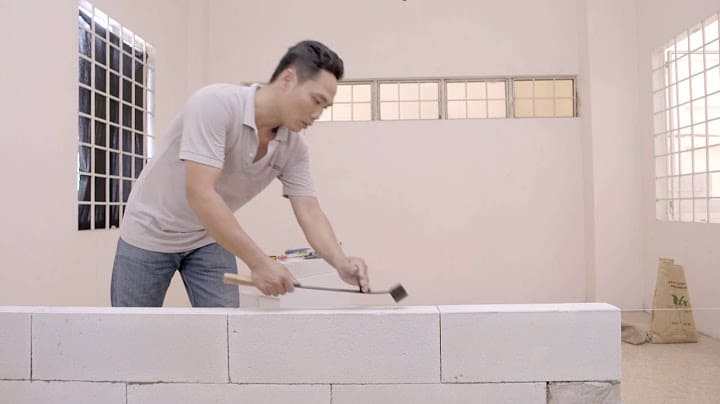
AAC blocks are not laid with site-mixed cement-sand mortar. They usespecialized mortar for AAC blocks, with joints approximately 3 mm thick instead of the 10–12 mm used for fired clay brick. Mortar consumption is therefore much lower. Ordering mortar based on fired clay brick norms causes surplus, while using the wrong mortar negates the benefits of AAC. Let the supplier calculate the number of bags from your wall area.
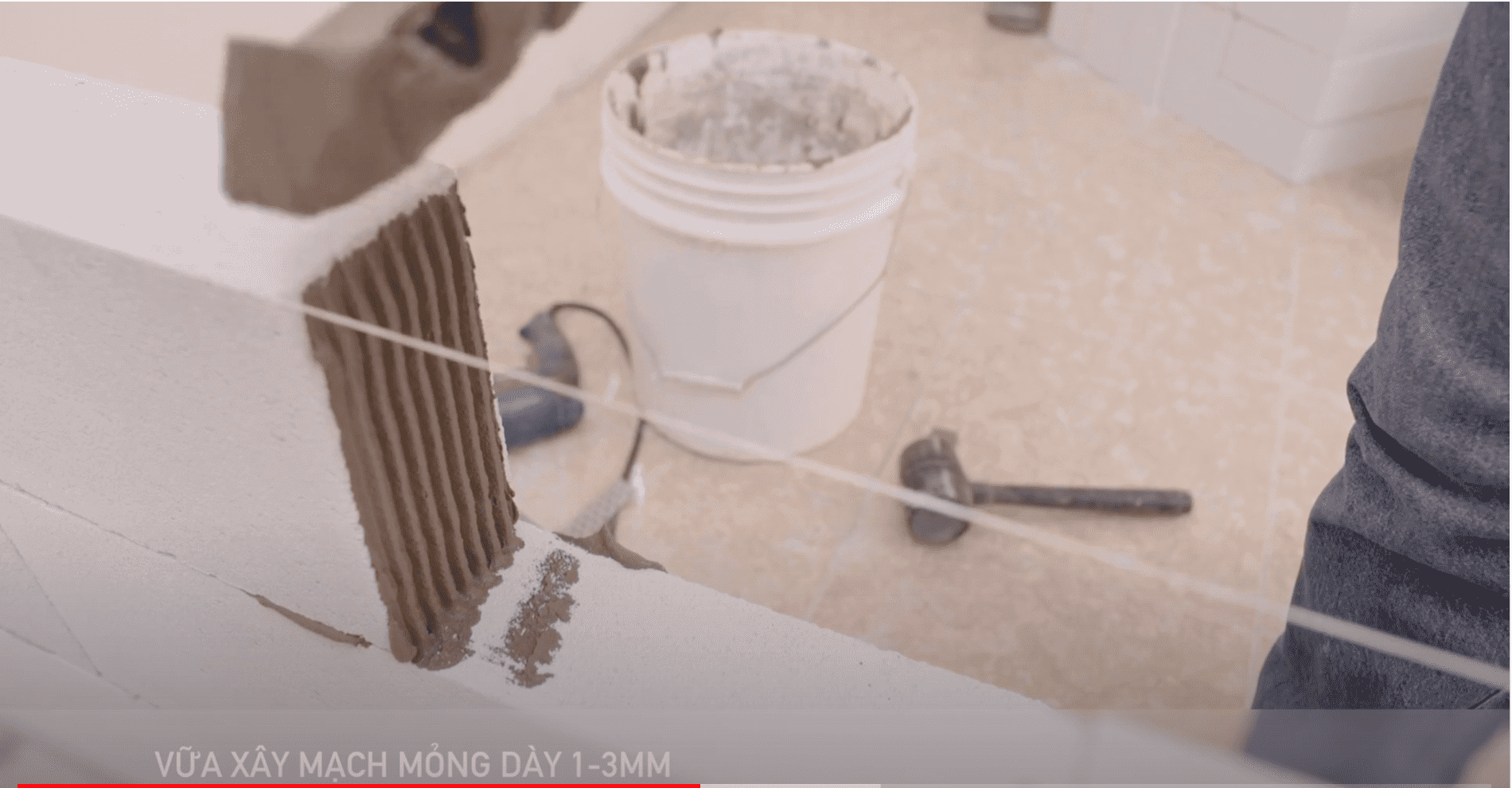
Specialized mortar for AAC blocks — joints are approximately 3 mm (the image states 1–3 mm) — is one reason AAC walls can be built faster and flatter than conventional masonry.
How are ALC panels calculated?
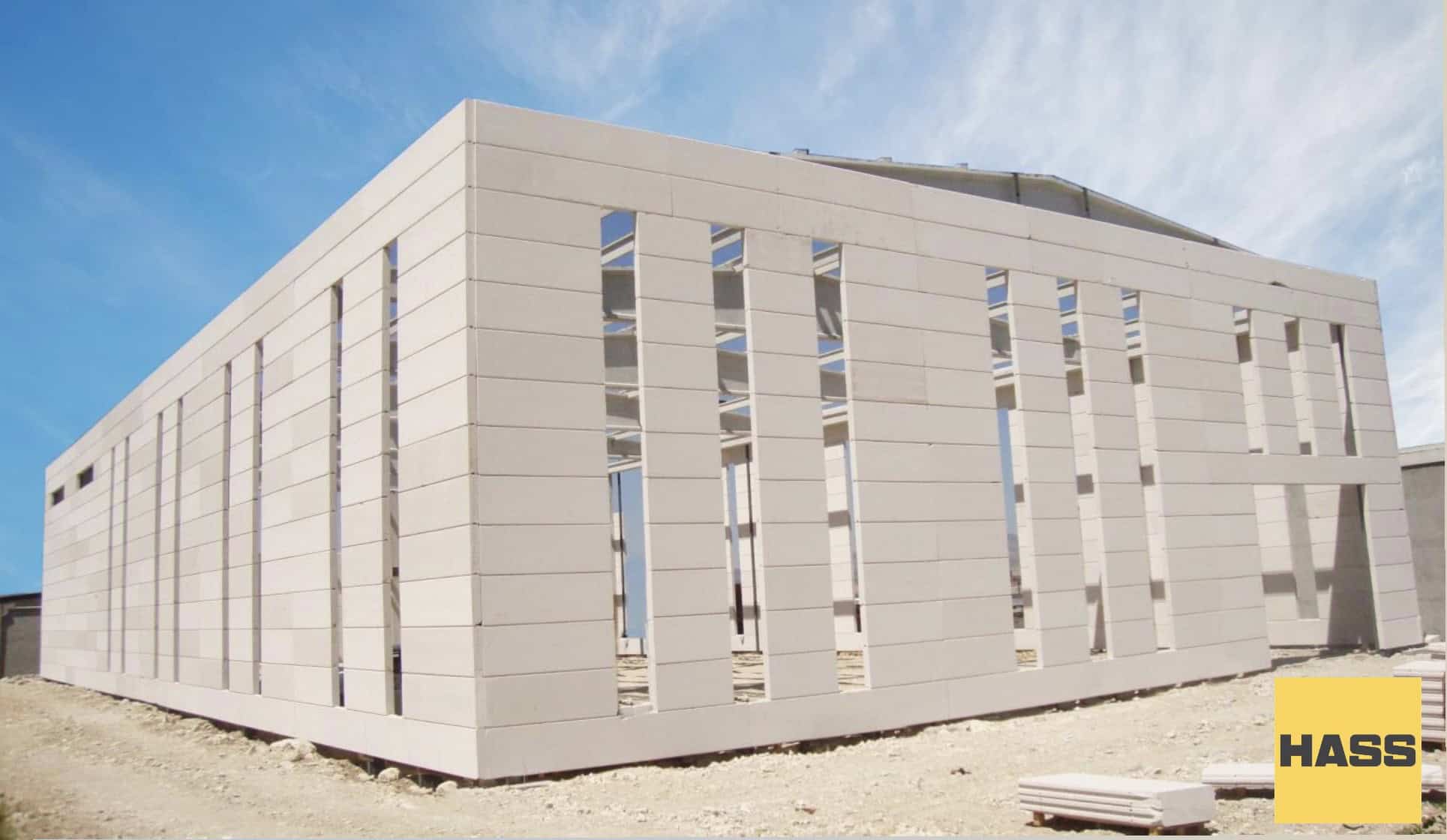
Prefabricated ALC panels are calculated bypanelrather than by block. Panel width is fixed at 600 mm, while length is made to order (500–3800 mm and normally matched to the clear wall height). The conversion to m³ remains the same — area × thickness — but the result is divided by the volume of one panel. Hand calculation is easier to get wrong than for blocks, so the tool below is recommended.
Prefer not to calculate by hand? 30 seconds is enough
HASS has incorporated the calculations above — together with actual factory consumption rates for masonry mortar, render, skimcoat and accessories — into itsfree material calculator. Enter wall dimensions (or m², or m³ if already known), select wall thickness, and immediately obtain the number of blocks, m³ to purchase and mortar bags. With one click, send these quantities to HASS for a quotation without retyping anything.
Note: all figures in this article and the calculator are reference estimates based on HASS consumption rates. Exact quantities depend on the drawings and actual site conditions. For contract quantities, send the drawings to HASS engineers for a free quantity take-off.
How many blocks does your house need?
Enter the wall area to get the number of blocks, m³ and mortar quantity immediately — free, with no registration.