Blog · News
The journey toward Net Zero for AAC blocks
1. What is Net Zero?
Net Zero, or “Net Zero Emissions”, is an environmental goal to reduce human-caused emissions of greenhouse gases (such as CO2, CH4, N2O) to levels that are in balance with the Earth's ability to absorb or remove emissions, to the point where total net emissions are reduced to zero.
This requires not only reducing emissions from sources such as transportation, industrial production and electricity generation, but also includes enhancing carbon sequestration through measures such as afforestation, forest conservation, and carbon capture and storage technology.
The goal of achieving net zero emissions is to mitigate the impact of climate change under the Paris Agreement, with the hope of keeping global temperature rise below 2°C and working to limit warming to below 1.5°C above pre-industrial levels. To achieve this, both governments, businesses and individuals need to commit to reducing emissions and supporting solutions for carbon sequestration, creating a lower carbon and more sustainable global economy.
Video of CO2 emitted into the atmosphere
2. Vietnam in the Net Zero race
At the COP26 Conference of the United Nations taking place in 2021, Prime Minister Pham Minh Chinh has made a commitment that Vietnam will achieve the Net Zero goal by 2050. At the same time, in the recently announced Power Plan VIII, the Government has also imposed a greenhouse gas inventory requirement on large enterprises, in order to promote the implementation of the country's carbon neutrality commitment.
In the power sector development plan to 2030, the target for controlling greenhouse gas emissions is set at about 204 to 254 million tons, expected to be from 27 to 31 million tons in 2050. We aim to reduce peak emissions to no more than 170 million tons in 2030, on condition that commitments under JETP of international partners are fully and effectively implemented.
Vietnam has also applied policies to encourage people to switch to using electric vehicles. Within three years from March 1, 2022, the first registration fee for battery-powered electric cars is 0%.
From March 1, 2025 to February 28, 2027, the registration fee for battery electric cars with a capacity of less than 9 seats will be 50% of the registration fee for gasoline cars equivalent in number of seats.
Vietnam will not build new coal-fired power plants after 2030, to ensure the reduction of carbon emissions and promote the goal of carbon neutrality, as committed at COP 26. Through the National Strategy on Climate Change and the National Strategy on Green Growth for the period 2021-2030, with a vision to 2050, the Government of Vietnam clearly demonstrates its determination and desire to develop the country in a sustainable, stable and prosperous direction.

As a country with great ambitions in the Net Zero strategy in Asia, Vietnam pledges to reduce emissions by 43.5% by 2030. However, pressure from increasingly strict environmental regulations from developed countries is pushing the Government and businesses in Vietnam to continue efforts and further strengthen the transition to a green and sustainable development model. Reducing emissions is not only a priority but also an urgent national imperative.
3. AAC blocks target Net Zero
AAC blocks or alc panels are a lightweight but sturdy and durable construction material, with extremely good thermal insulation and 4-hour fire resistance. Autoclaved aerated concrete blocks can achieve Net Zero and negative carbon potential, AAC has a role as
a construction material that helps reduce the life cycle of emissions of construction projects, thereby absorbing more carbon dioxide from the atmosphere than it produces.
The majority of CO2 emissions come not from the production of AAC but from the production of two key raw materials, cement and lime, so the Net Zero roadmap is based on the decarbonization of the cement and lime manufacturing industry.
4. What is AAC?
AAC first appeared in 1929 in Europe, including aac tiles, alc wall panels, alc floor panels. Due to its light weight (20% of the weight of conventional concrete), AAC saves construction time, 2-5 times faster with AAC than traditional methods. AAC is also durable and has a lifespan of up to 150 years.
AAC has become the most widely used construction material in the world, for residential, commercial, and industrial uses. In Europe, AAC volumes are expected to remain stable at around 17.5 million m3 per year, equivalent to 400,000 homes.
In Vietnam, autoclaved autoclaved aerated concrete blocks are also known by many names such as: AAC blocks, lightweight concrete bricks, ultra-AAC lightweight blocks, non-fired masonry units, autoclaved bricks... In addition, longer large format AAC blocks, with steel cores, are called autoclaved aerated concrete panels, there are many other names such as: alc wall panels, lightweight concrete panels, ultra-light concrete panels, alc floor panels, alc panels, ultra-light concrete panels...
5. AAC production process
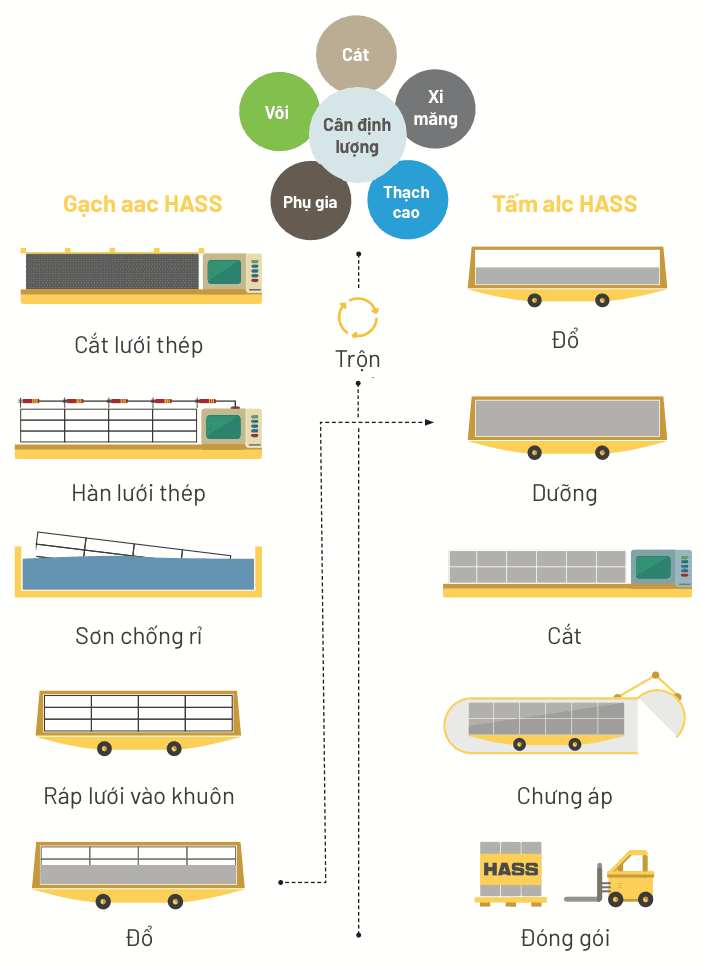
AAC is produced from cement, lime, sand, gypsum, water and a small amount of additives. The ingredients are mixed and poured into the mold, a number of chemical reactions take place giving AAC its light weight and heat insulating properties.
In an alkaline mixture of ingredients, the chemical reaction creates millions of hydrogen bubbles. Hydrogen gas increases the volume of the mixture, creating bubbles about 3 mm in diameter.
At the end of the curing process, hydrogen escapes and is replaced by air holes, accounting for 60-85% of the volume of AAC.
"AAC cake" when removed from the mold has enough mortar hardness to be cut into required sizes, then put into an autoclave at high pressure and temperature. When the temperature in the autoclave reaches 190°C and the pressure reaches 800
to 1,300 kPa, quartz sand reacts with calcium hydroxide to form calcium silicate hydrates – especially tobermorite
– gives AAC its unique properties.
Video of AAC production at HASS factory
6. What is AAC's carbon footprint?
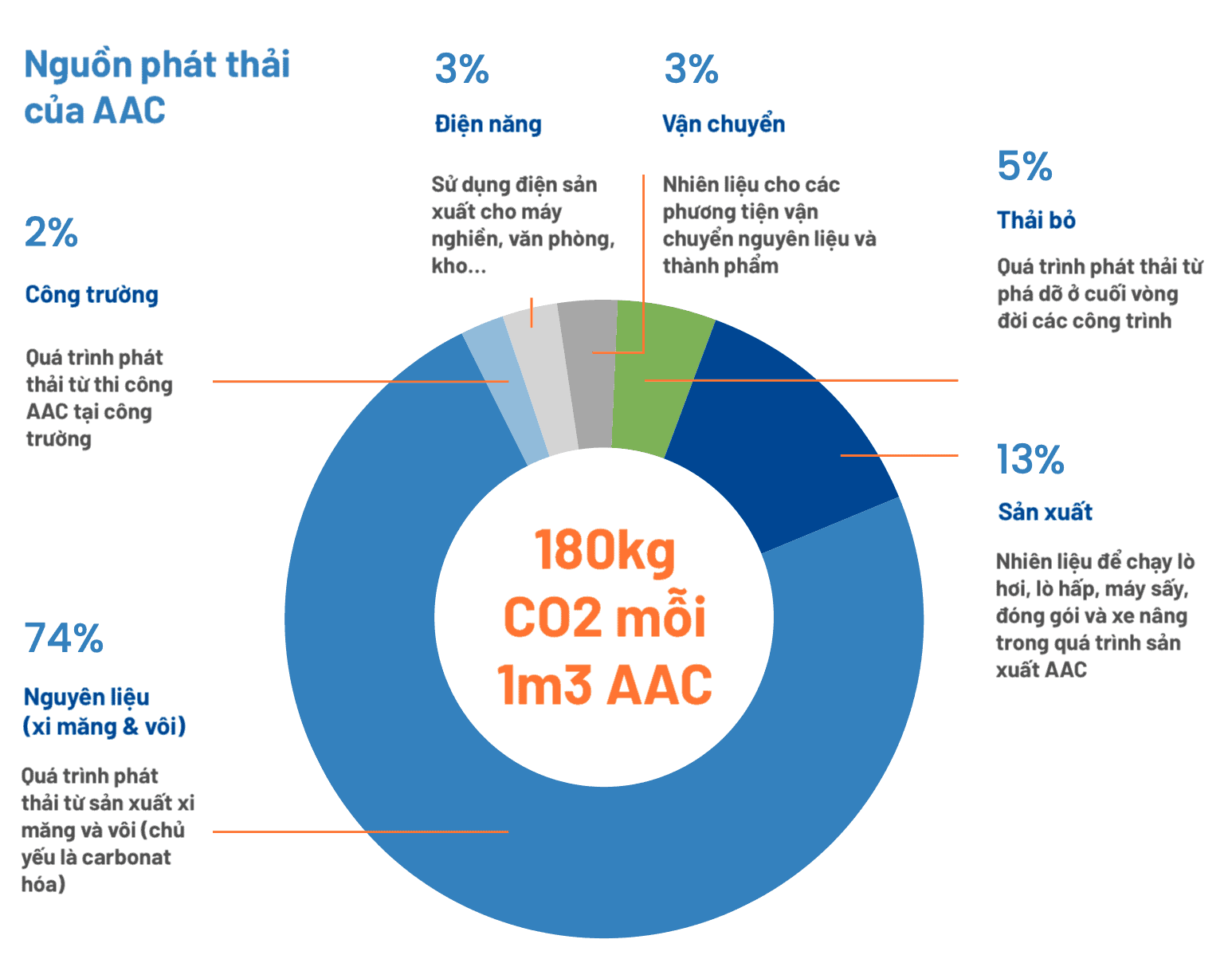
Based on life cycle analysis, the majority of emissions – about 74% – come from the production of cement and lime. About 13% of emissions come from AAC production itself.
Based on life cycle analysis (LCA), the majority of CO2 emissions do not come from the production of AAC but from the production of two key raw materials – cement and lime, which account for about 74% of the life cycle emissions of an AAC product.
These emissions are located upstream from cement and lime manufacturers, and are the inevitable result of the chemical reaction that occurs when carbon is removed from limestone to create clinker, the main ingredient in cement. The CO2 released in this reaction makes the decarbonization of cement and lime difficult, although not impossible.
Emissions from the AAC production process at factories account for about 13% of emissions during the product life cycle. The main source of these manufacturing emissions is fossil fuels such as coal and natural gas used to power the boilers that supply steam to the autoclave.
AAC can absorb 77 kg CO2/m3 over its lifetime through decarbonization, a process where cement and lime products naturally absorb CO2 from the air, with 80% of the decarbonization absorbed after 50 years and 95% within 80 years.
7. AAC's roadmap to Net Zero?
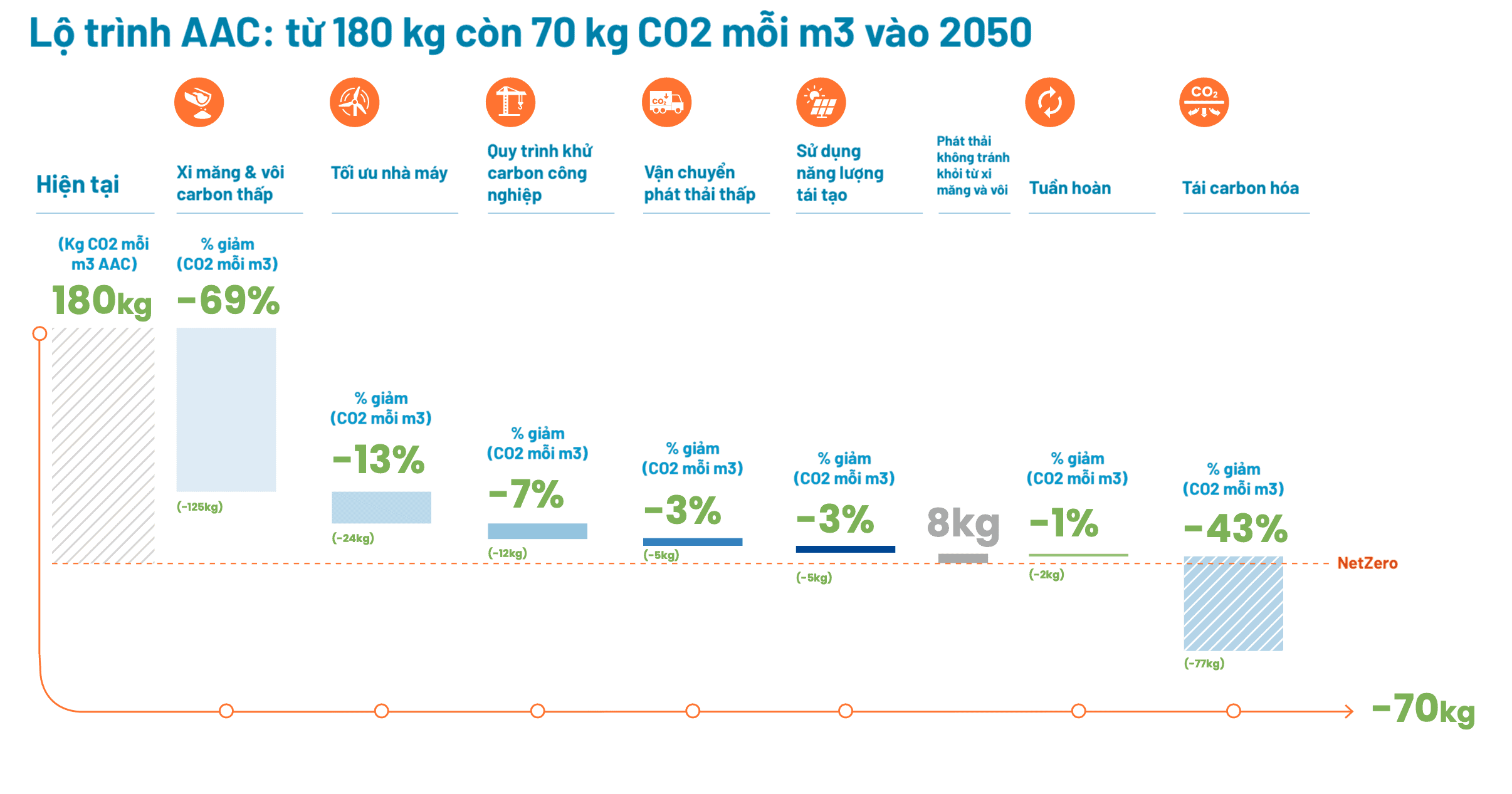
The Zero Carbon Roadmap sets out a path for AAC products to reach net zero emissions by 2050 and has the potential to make AAC products carbon negative through recarbonization, thereby absorbing more carbon dioxide from the atmosphere than they produce.
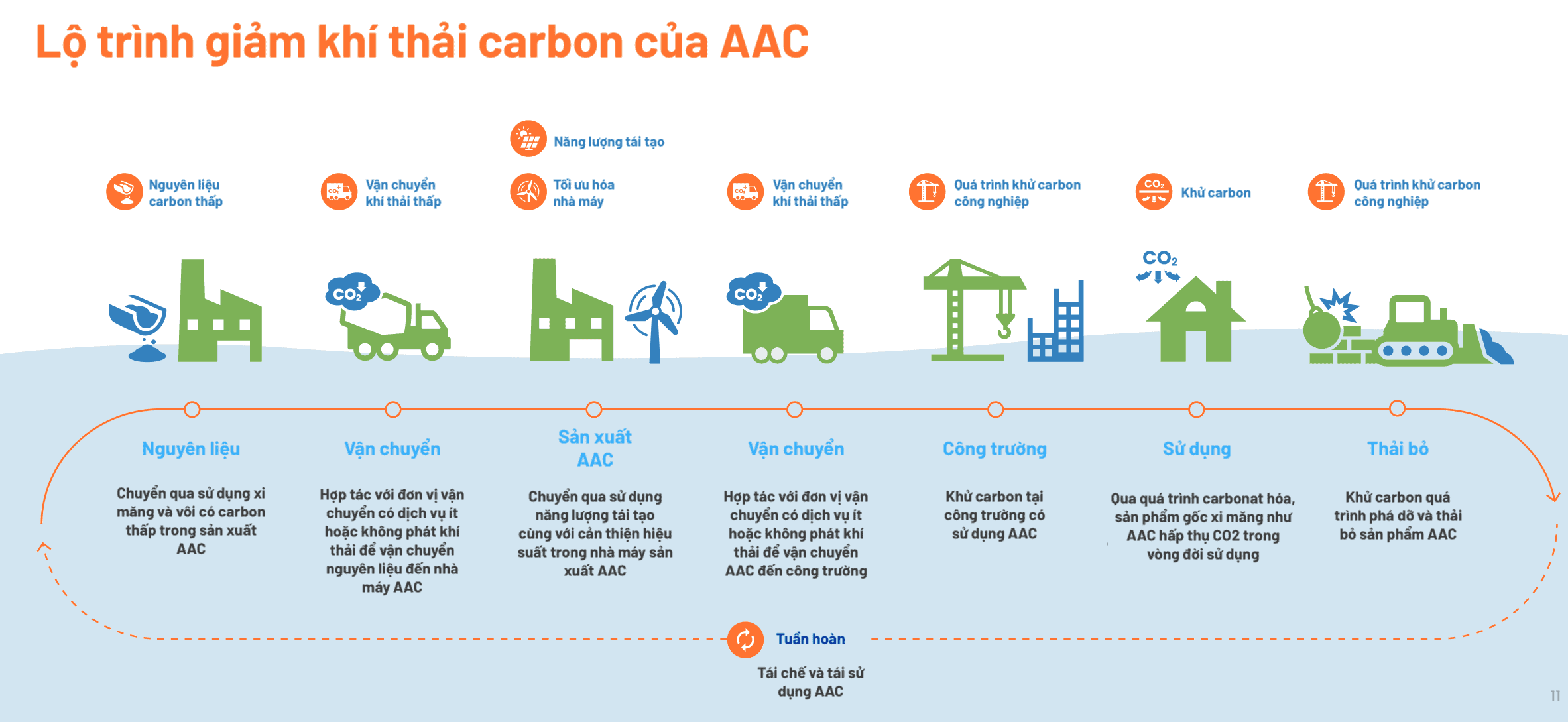
The two key levers to achieve Net Zero are the use of low-carbon lime and cement feedstocks and the shift to renewable energy sources along with improving efficiency in AAC manufacturing plants. Two other levers – circularity and recarbonization – have the potential to make AAC products carbon negative.
Low carbon cement and lime
The use of low carbon cement and lime binder in AAC production will reduce carbon emissions by 69%. According to the roadmap, decarbonization of the cement and lime industry will be achieved through the use of:
- Captured Carbon Storage and Utilization (CCS & CCU)
- Low carbon clinker through the transition from fossil fuels to renewable energy
- Alternative adhesive
- Replace clinker
- Carbon neutral shipping
- Recarbonization
Fuel source conversion and plant optimization
The emissions associated with AAC production are significantly lower than those from cement and lime. Efficiency improvements coupled with switching to renewable energy sources for use in the factory will reduce emissions by 13%.
Circularity
Recycling and reusing AAC has the potential to reduce emissions by up to 15%, then down to 1% by 2050 as cement and lime are decarbonized. In AAC production, up to 20% of cement and lime can be replaced by using:
- AAC errors from the manufacturing process
- AAC cut excess from construction sites
- AAC was recovered and demolished
Recarbonization
Cement-based products absorb CO2 throughout their life. This recarbonization process will reduce total emissions by up to 43% and has the potential to make AAC products carbon negative. AAC products can absorb 77 kg of CO2 per m3 if complete recarbonization is achieved.
Go beyond Net Zero
Fully deployed, the above levers could help reduce AAC emissions from 180 kg to -70 kg CO2/m3 by 2050, thereby removing more carbon from the atmosphere than it produces.
8. Where to buy AAC blocks?
Please call now so we can accompany you.
Factory: No. 99 DT747, Thanh Phuoc, Tan Uyen, Binh Duong, Vietnam (Directions here)
Reference source: EAACA
(HASS Editorial Board)
Need a quotation or technical advice?
Send a request and the HASS technical team will respond during business hours.